Working Methods | WORK PANORAMA

The Reconstruction of the World of Work in an Age of Uncertainty
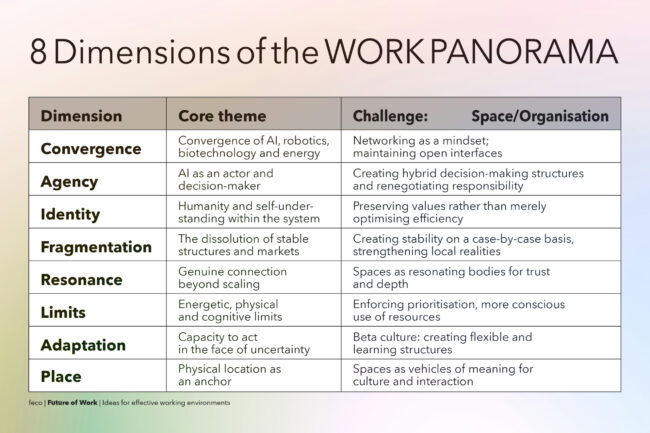
How the WORK PANORAMA provides guidance, contextualises technological dynamics and redefines the physical workplace.
We are experiencing a period in which technological possibilities are accelerating exponentially, whilst traditional certainties are crumbling. Against this backdrop, the WORK PANORAMA is not a rigidly formulated forecast of the future, but a multi-layered framework for understanding our world of work.
The Panorama is conceived by Raphael Gielgen, Trendscout for the Future of Work, Life & Learn at Vitra, who continuously analyses shifts in the world of work based on global observations, studies and travels. As a long-standing partner, feco presents this pioneering discourse annually as part of a live session at the feco-forum in Karlsruhe, with the aim of transforming abstract signals of the future into built spatial reality.
The core themes in a state of perpetual becoming
WORK PANORAMA is guided by the theme ‘State of Becoming’ – a reality in which certainties are becoming rarer and adaptability is becoming a prerequisite for survival. The driving force behind this dynamic is convergence: innovation no longer arises in isolated silos, but at the interfaces between artificial intelligence, robotics, data networks and new energy systems. At the same time, a shift towards Agency is taking place: technology is transforming from a passive tool into an autonomous actor that controls processes and prepares decisions. This raises fundamental questions: how does responsibility change when humans and machines make AI-supported decisions together?

Identity, Fragmentation and the Search for Resonance
Whilst technological systems are converging on a global scale, the physical world is experiencing increasing ‘fragmentation’ of political and economic order. Stability can no longer be taken for granted, but must be generated on a case-by-case basis (‘adaptation’). Furthermore, technological progress is coming up against physical and energetic ‘limits’. In this complex environment, human ‘identity’ is changing: where algorithms anticipate thoughts, there is a risk that humans will become nothing more than measurable metrics. In an increasingly optimised world, emotional relevance is becoming the scarcest resource. Spaces must therefore do more than merely fulfil a function – they must foster genuine human ‘resonance’ and depth.

Conclusion: ‘Place’ – the physical location as an emotional anchor for transformation
WORK PANORAMA offers a clear insight into the future of the world of work: successful organisations are moving away from rigid five-year plans and establishing an iterative ‘beta culture’ – characterised by openness, a willingness to experiment and the courage to act in the face of uncertainty.
For architecture, this marks a paradigm shift: the physical space is losing its monopoly as a mere place for carrying out work, yet is gaining inestimable value as an irreplaceable anchor for identity, culture, trust and a sense of belonging. The offices of the future are not finished monuments, but flexible, learning systems that integrate technology, create space for human interaction and make a sense of connection tangible.
Explore further: Media & Downloads
Explore the ideas from WORK PANORAMA in more depth through the recording and accompanying documents:
Session recording: Watch the keynote speech at the feco-forum
WORK PANORAMA 2026
Overview poster: The trend matrix for strategy meetings
Poster WORK PANORAMA 2026
Encyclopaedia of Work: Collection of articles on the future of work
Concepts relating to the future of knowledge work
Gartner Research: Strategic Technology Trends (Convergence, Agentic AI & Multi-agent Systems)
Gartner: The Key Technology Trends for 2026
FAQ – WORK PANORAMA
-
WORK PANORAMA is developed independently by Raphael Gielgen (Future of Work trend scout at Vitra). Each year, feco provides a platform for WORK PANORAMA at the feco-forum in Karlsruhe to translate these forward-looking ideas into real-world spatial concepts.
-
It highlights the need for constant adaptability. Rooms must no longer be built in a rigid manner, but must remain adaptable to new processes at all times, for example through modular furnishing systems and movable partition walls.
-
Because purely functional tasks and data processing can be digitised. As a result, physical space becomes an indispensable environment for fostering identity, trust, corporate culture and genuine human interaction.
We are at your service.
We are at your service.
Visit us in the feco-forum on more than 3.500 square meters.
Arrange a consultation