Working Methods | Desksharing

Flexibility requires clear structures
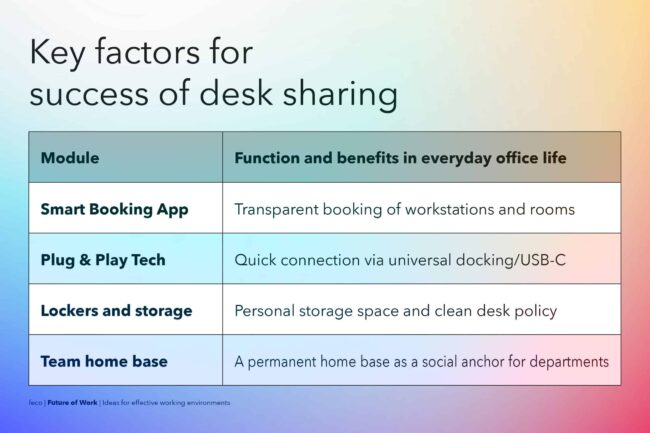
How smart booking tools, ergonomics and psychological anchors make desk sharing a model for success.
In modern, hybrid working environments, an average of 30 to 50 per cent of traditional desks remain unoccupied due to working from home, business travel and flexible working hours. Against this backdrop, desk sharing has established itself as an economic standard. However, without a well-thought-out concept, simply increasing space utilisation can quickly lead to unrest and frustration within the team. A successful sharing model therefore views desk-sharing not merely as a cost-saving measure, but as an emotional and organisational challenge. As a result, the office is transformed from a collection of personal desks into a needs-based working environment that makes optimal use of space and takes human needs into account.
Understanding the emotional logic: loss of territory and orientation
Doing away with fixed desks has a profound impact on employees’ sense of orientation. Workplace analyses show that the aversion to free choice of seating is often driven by a fear of losing control and identity. A successful transformation must therefore take into account the emotional logic of the workplace.
If physical consolidation is to succeed, clear rules, transparent communication and visible signs of appreciation are needed. If emotional barriers are not broken down, staff will seek refuge in working from home. Intelligent software solutions support this process: workstations that can be reserved via an app provide security, make attendance transparent and prevent time-consuming searches.
Ergonomics and hardware: Rapid changes in the working day
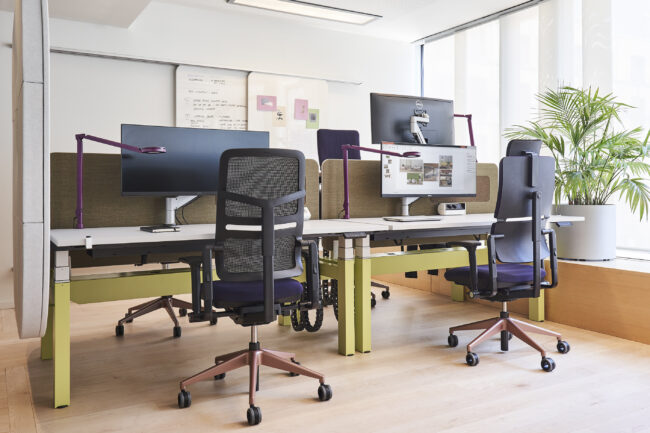
High-quality ergonomic standards are essential to ensure that these daily changes run smoothly. Motorised height-adjustable sit-stand desks, universal docking stations and easily adjustable office chairs allow for adaptation to different users within a matter of seconds. The infrastructure is complemented by a consistent clean-desk policy and personal lockers in which work equipment can be stored securely. However, functional hardware alone is not enough: only when the physical environment is combined with a supportive corporate culture does mere spatial efficiency transform into a flexible working culture that is embraced by the workforce.
Conclusion: Team home bases as a social anchor in the sharing model
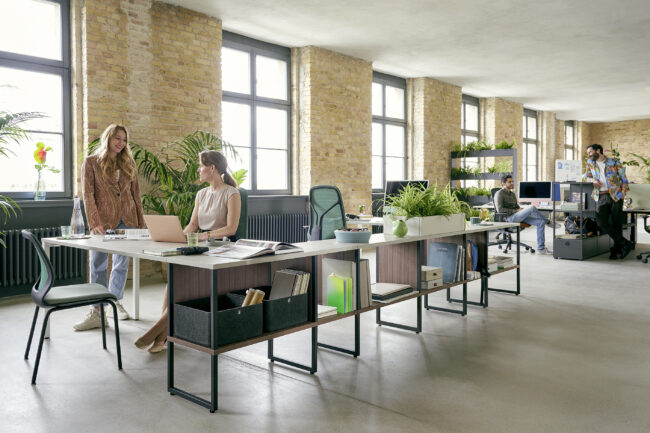
To effectively counter the loss of one’s own territory, the concept of team home bases has proven its worth. Departments are assigned a fixed home base, within which desks can be swapped freely. This preserves a sense of belonging and social identity, whilst at the same time utilising the necessary flexibility in space. Combined with soundproof partitions and zoned quiet areas, desk sharing transforms from a dreaded cost-cutting measure into a genuine asset. The physical space loses its role as a rigid place of attendance and gains enormously as a vibrant, highly functional hub for culture, exchange and collaboration.
Find out more: Media & Downloads
Make use of further information from our specialist sources and empirical studies to optimise your planning processes in detail:
Journal of Environmental Psychology: Empirical studies on user acceptance of shared workspaces
Environmental Psychology Research on Shared Desks
Industry Association for Offices and the Workplace (IBA): Technical paper on the psychological dimension of desk sharing
Densification and the emotional logic of desk-sharing
Fraunhofer IAO: Recommendations for flexible workplace concepts, desk sharing and sustainable space strategies
Prospects for the working world of tomorrow
FAQ – Desksharing
-
Desk sharing is a flexible workplace model in which several employees share a certain number of desks. Fixed, personal workstations are replaced by zones organised according to need.
-
Software tools enable transparent booking of workspaces in advance, show where team members are working, and automatically release unused bookings. This saves time spent searching and prevents frustration.
-
Through a mandatory clean-desk policy, sufficient personal storage space (lockers), standardised technical specifications (plug-and-play via USB-C) and the organisation of the office into departmental or team-based workspaces.
We are at your service.
We are at your service.
Visit us in the feco-forum on more than 3.500 square meters.
Arrange a consultation