Productivity | Lighting design
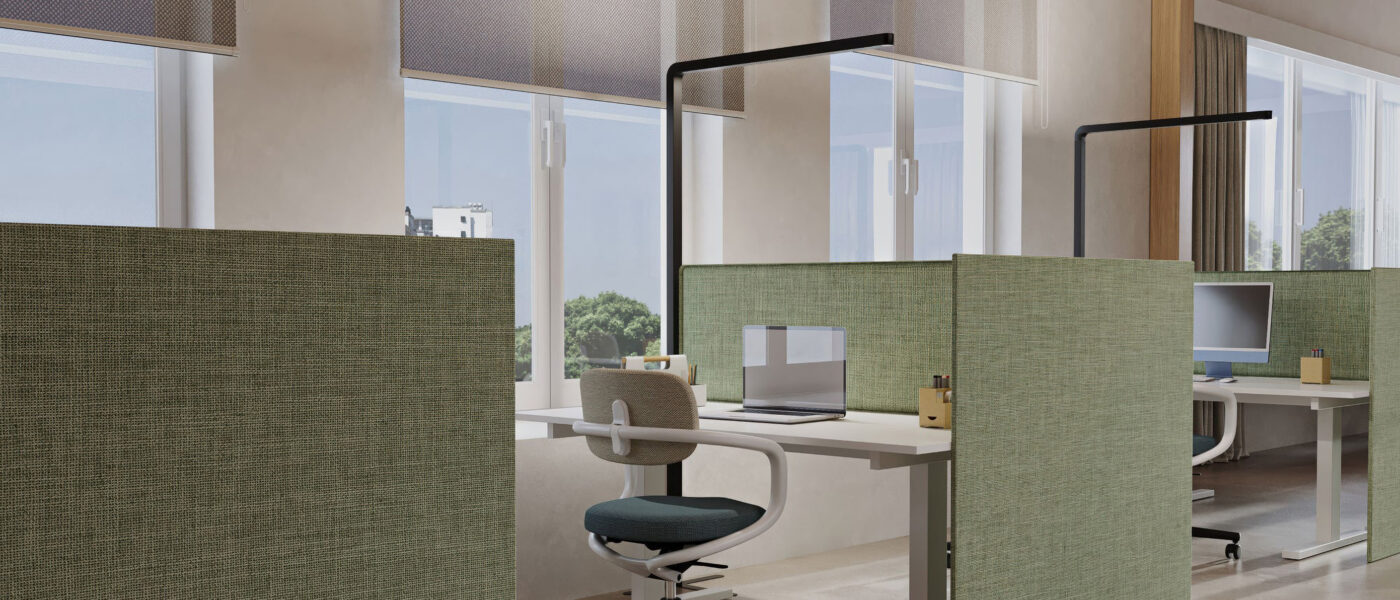
Daylight and Human-Centric Lighting in the Workplace.

Tailored lighting concepts promote well-being and concentration and support the functional zoning of modern working environments.
Professional lighting design has a significant influence on employees’ visual perception, performance and well-being. Inadequate lighting can lead to visual fatigue, headaches and a loss of concentration. The fundamental regulatory requirements for office lighting are set out in the German Workplace Regulation ASR A3.4 and the DIN EN 12464-1 standard. These establish binding specifications for illuminance, colour rendering, uniformity and glare control. Professional lighting design therefore forms the foundation for safe and healthy workplaces.
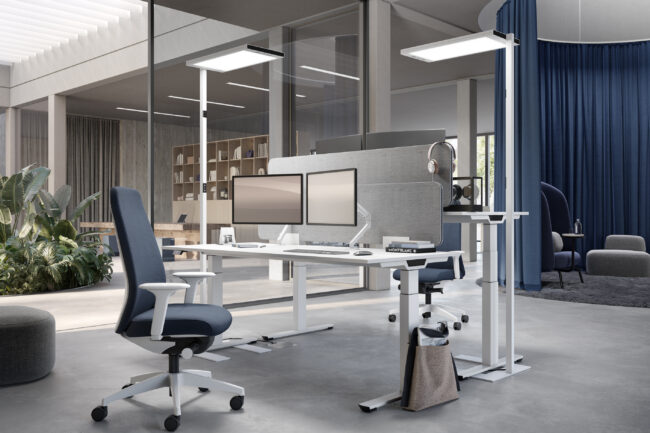
Illuminance and glare control in accordance with DIN EN 12464-1
DIN EN 12464-1 defines lighting requirements for different visual tasks. The frequently cited figure of 500 lx applies to typical computer workstations, but not across the board to the entire office. Modern lighting design makes a clear distinction between work, communication, meeting and lounge areas. Illuminance levels tailored to specific needs improve visual comfort, the quality of the environment and energy efficiency. A balanced combination of direct and indirect lighting, together with glare control in accordance with the standard (UGR < 19, e.g. through microprismatic louvres), creates pleasant visual conditions and supports visual communication.

The use of daylight in spatial planning and Human Centric Lighting
Forward-looking lighting architecture combines daylight with artificial lighting. Human Centric Lighting (HCL) takes into account not only the visual but also the biological effects of light. Dynamically controllable LED systems adjust illuminance and colour temperature to the time of day in order to support the natural circadian rhythm. Research shows that biologically effective light achieves its full effect when combined with daylight and well-designed interior architecture. Transparent glass partition walls allow ample daylight to enter, improve orientation and reduce the need for artificial lighting.
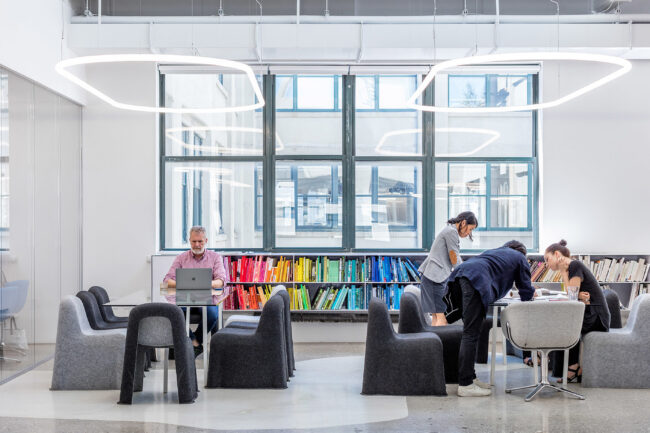
Light as an element of spatial zoning
Light is an important design element in modern office architecture. Contemporary working environments consist of areas with different uses – ranging from individual workstations and communication zones to meeting rooms. The lighting is specifically tailored to the respective use. Different lighting scenarios make areas of use intuitively recognisable and support various ways of working. Whilst areas for concentrated work require uniform, glare-free illumination, communication zones with adjusted light levels create a relaxed atmosphere. This enhances quality and saves energy.
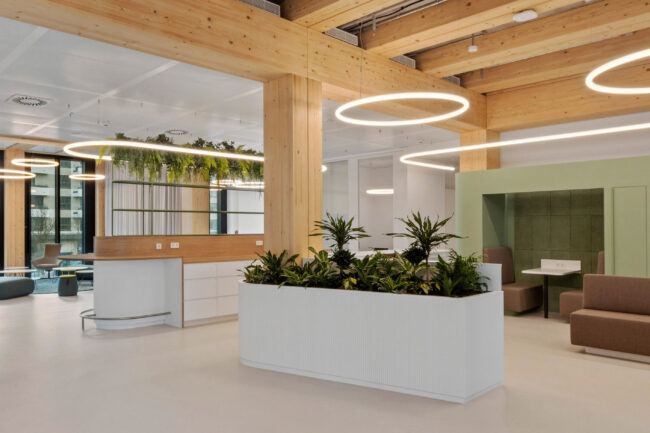
Lighting design for hybrid collaboration
Hybrid meeting rooms place particular demands on lighting technology and interior design. For successful video conferences, uniform vertical illumination of faces, high colour rendering and completely glare-free lighting conditions are essential. These factors improve both the direct perception of people in the room and the transmission and image quality for participants joining remotely. Flexible lighting controls also allow for easy adaptation to different usage scenarios, such as meetings, interactive workshops or screen presentations.
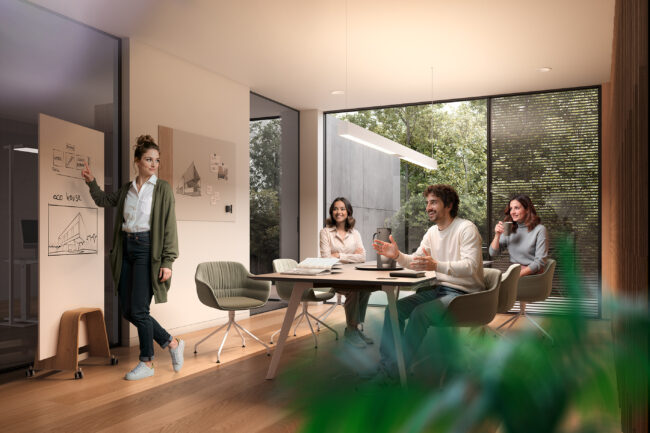
Conclusion: Lighting design as a factor in well-being and a mark of quality
Holistic lighting design goes far beyond mere compliance with minimum requirements. It harmoniously combines lighting that meets standards with maximum use of daylight, intelligent control and the differentiated zoning of various work areas. This creates highly functional working environments that specifically promote employees’ health, wellbeing and productivity. At the same time, sustainability, energy efficiency and architectural design quality are brought together. Modern lighting concepts therefore form an indispensable component of future-proof office planning.
Find out more: Media & Downloads
Make use of further information from our specialist sources and empirical surveys to optimise your planning processes in detail:
BAuA Technical Occupational Safety: The ASR A3.4 sets out binding minimum values for illuminance levels and sight lines.
Lighting and line of sight
Fraunhofer IAO: User acceptance and energy efficiency of LED lighting, as well as biologically effective lighting concepts.
LightWork in the knowledge-based workplace
German Social Accident Insurance: Planning ergonomic lighting concepts.
Office lighting
FAQ – Lighting design
-
Human Centric Lighting (HCL) refers to lighting concepts that take into account not only visual requirements but also the biological effects of light. A carefully balanced combination of daylight and artificial lighting can help to promote well-being, alertness and the ability to concentrate.
-
For computer workstations, DIN EN 12464-1 generally recommends an illuminance of 500 lx on the work surface. However, the specific visual task is the decisive factor. Modern lighting design is therefore tailored to the different areas of use and does not prescribe the same illuminance for all office spaces.
-
Modern office designs distinguish between areas for concentrated work, communication, meetings and informal interaction. The lighting is therefore tailored to the specific use of each area. Illuminance levels planned to meet specific needs improve visual comfort, the quality of the environment and energy efficiency, whilst also supporting the spatial zoning of the space.
We are at your service.
We are at your service.
Visit us in the feco-forum on more than 3.500 square meters.
Arrange a consultation