Working Methods | Activity Based Working
The workplace of the future is shaped by the task at hand.
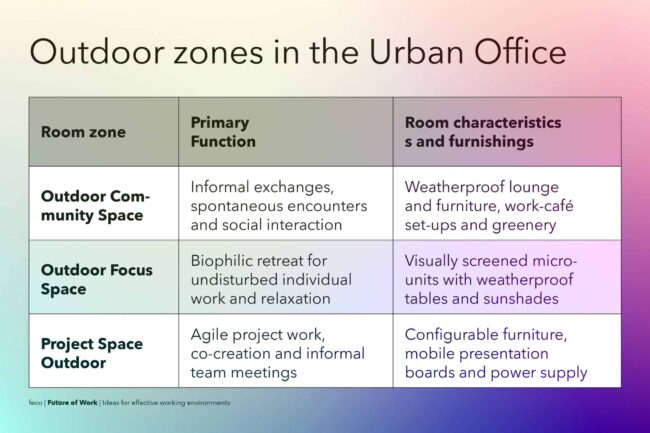
Why the fixed desk has had its day and how the urban office model enhances concentration, collaboration and productivity.
Modern knowledge work is characterised by a wide variety of tasks: throughout the working day, employees constantly switch between highly focused individual work, confidential telephone calls, creative team workshops and informal discussions. The traditional office concept, with rigidly assigned individual workstations, is reaching its limits, as a standard desk cannot adequately meet these contrasting requirements.
With Activity-Based Working (ABW), the specific task takes centre stage in space planning. Employees can flexibly choose where to work from specially designed functional areas. Inspired by urban neighbourhood concepts, this creates a zoned spatial structure that promotes personal responsibility, a sense of community and belonging. Workplace analyses show that this freedom of choice boosts performance and sustainably strengthens commitment and productivity within the organisation.

The Urban Office as a spatial blueprint
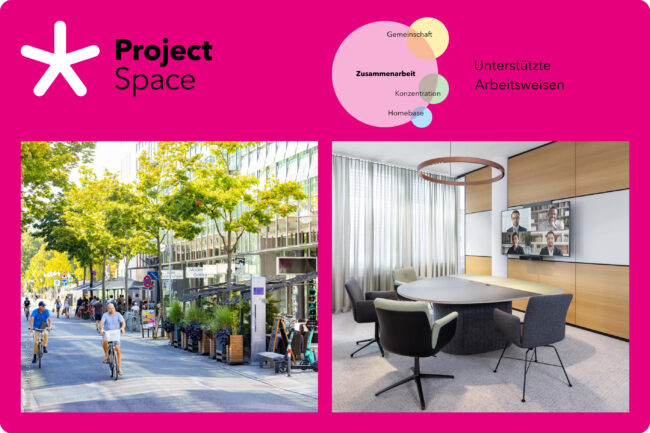
A tried-and-tested model for the architectural implementation of ABW is the Urban Office model, which feco also uses in its spatial planning. It applies the functional structure of a city to the physical office space. A city functions so well because it combines urban principles: marketplaces for social interaction, residential neighbourhoods for a sense of place, workplaces for productivity, and parks and quiet zones for relaxation. Applied to the modern office, this creates four spatial zones: the Community Space serves as a vibrant hub for social interaction and culture. The Team Space provides a reliable environment as a neighbourhood for collaboration. The Focus Space is designed as a sheltered retreat for undisturbed individual work, confidential calls and intensive dialogue with AI systems (e.g. voice prompting and AI sparring), whilst the Project Space is a dynamic area focused on agile collaboration.

Holistic success through space, behaviour and organisation
The key advantage of this activity-based approach lies in its effective prevention of conflicts over space usage and acoustics. Whilst in conventional open-plan offices background noise and conversations severely impair concentration, the physical separation of communication and quiet zones ensures high-quality room acoustics.
However, successful implementation requires far more than mere changes to the furniture: it is crucial that employees intuitively understand the different areas and that managers actively exemplify the underlying principle of trust. When movable partition walls provide sound insulation and digital booking systems manage capacity utilisation, the space becomes a strategic tool.

Space zones as drivers of productivity and focus
By switching between functional areas in a targeted manner, employees gain full control over their working environment. This autonomy reduces cognitive strain and boosts personal motivation.
Through wall structures and acoustic screening, the Focus Space ensures that confidential discussions, AI-supported work processes and complex analyses can be carried out without visual or auditory distractions. At the same time, the Community Space, Team Space and Project Space provide the necessary space for social interaction, straightforward knowledge sharing and team dynamics.
Conclusion: Strategic Outlook
Activity-Based Working breaks down the rigidity of fixed workstations and creates a dynamic working environment. Through its four coordinated functional zones, the Urban Office principle combines acoustic protection for focused work with inspiring spaces designed to foster successful collaboration.
The transformation to a bespoke working environment requires a systematic needs analysis. feco provides comprehensive support to companies – from space assessments through to the implementation of an effective working environment. This concept can be experienced first-hand at the feco-forum in Karlsruhe. feco’s experts are available at any time to provide individual specialist advice.
Further reading: Resources & Downloads
Make use of in-depth information from our specialist sources and empirical studies to optimise your planning processes in detail:
Fraunhofer IAO (Office 21): Long-term collaborative research project on future-proof spatial structures, ABW and success factors for team-oriented working environments
Office 21 Research Platform
IBA study: Research into flexible, hybrid and office-based working models, and the impact of the working environment on staff satisfaction.
Working models and HR practices
IBA study: Representative forsa survey on trends in office work and expectations of modern working environments.
The current state of office work
FAQ – Activity Based Working
-
With activity-based working, there are no longer any permanently assigned desks. Instead, staff choose the most suitable area of the office depending on their current task (e.g. focused work, brainstorming, customer calls).
-
The Urban Office divides the office space, much like a city, into the Community Space (socialising), the Team Space (collaboration), the Focus Space (concentration & deep work) and the Project Space (co-creation). This enables clear acoustic separation and boosts productivity.
-
The Focus Space serves as an acoustically and visually screened retreat for undisturbed individual work, interactive AI tasks (e.g. verbal prompting) and confidential telephone calls. It protects staff from disturbances and prevents AI voice dialogues from disrupting the acoustics in the open-plan office.
We are at your service.
We are at your service.
Visit us in the feco-forum on more than 3.500 square meters.
Arrange a consultation