Working Methods | Outdoor Office

The open-air office: outdoor spaces as functional areas
How companies are using their roof terraces and courtyards as an extension of the urban office to promote collaboration, concentration and well-being.
In urban conurbations, workspaces are becoming increasingly compact, whilst the average per-capita office space is decreasing. Companies are faced with the challenge of making optimal use of existing space whilst simultaneously creating incentives for in-person attendance, health and creativity. Outdoor areas such as roof terraces, balconies and courtyards are being transformed from mere break areas into fully-fledged working environments. As a functional extension of the interior, the outdoor office utilises the building’s so-called ‘fifth façade’.

The ‘fifth façade’: gaining space and expanding the urban office
Unused roof spaces and courtyards offer considerable potential for additional space. In the context of the urban office, based on the principles of activity-based working, outdoor spaces take on the role of urban parks or public squares. They bring variety to the working day and prevent a feeling of confinement. By combining biophilic design, fresh air and flexible spatial elements, expanded spaces are created for the four core zones of the Urban Office. The alternation between periods spent working on digital screens indoors and analogue reflection outdoors enhances mental wellbeing and boosts staff performance.

Biophilic design and cognitive regeneration
Humans have a natural need to connect with nature (biophilia). Spending time in green spaces has been shown to reduce stress levels, alleviate cognitive strain and stimulate thought processes. During brief outdoor meetings or casual discussions whilst strolling through the community space, rigid patterns of thought can be broken down more quickly than in enclosed meeting rooms. In the outdoor office, biophilic design is not limited to plants; it also utilises natural daylight, fresh air and tactile materials such as wood or coated cast metal to create a balancing counterpoint to the digitalised world of work.

Requirements for infrastructure and furniture
It is only the combination of ergonomics, weather resistance and technical infrastructure that turns outdoor spaces into reliably usable workspaces::
Weather-resistant materials: Use of UV-resistant, corrosion-free and easy-to-clean materials (e.g. powder-coated aluminium, special steels or sustainable woods).
Ergonomics & flexibility: Height-adjustable tables and ergonomically designed seating that allow for prolonged work without causing postural problems.
Sun protection & media technology: Glare-free zones provided by awning systems or pergola structures, as well as weather-protected power and Wi-Fi connections.
Further reading: Media & Downloads
Make use of in-depth information from our specialist sources and empirical surveys to optimise your planning processes in detail:
feco-forum HimmelReich: A practical example of the functional design of roof terraces and outdoor furniture.
A place to connect
Gensler Research: Research paper on the empirical effects of biophilic design, open spaces and outdoor areas in the workplace.
Biophilic Design & Outdoor Spaces
DGNB: Catalogue of criteria for amenity, roof terraces and weatherproof outdoor workspaces in the office building standard.
DGNB criterion: quality of stay
FAQ – Outdoor Office
-
Outdoor office furniture must be extremely weather-resistant, UV-resistant and corrosion-proof in order to remain outdoors all year round. Unlike furniture designed purely for leisure or the hospitality industry, professional outdoor office furniture offers ergonomic seating positions, appropriate table heights and integrated solutions for glare control and sun protection.
-
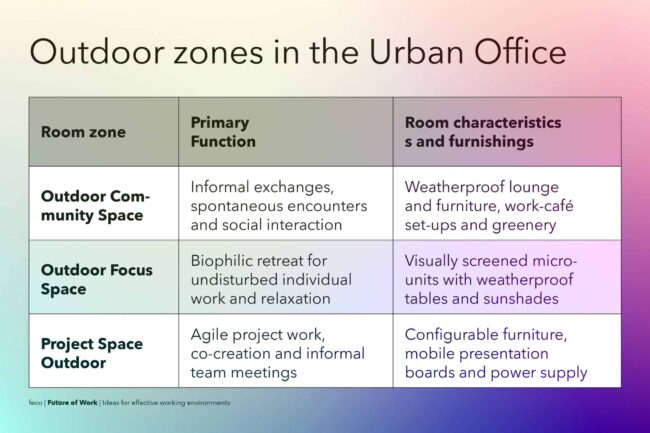
The Outdoor Office expands on the existing zones of the Urban Office. It primarily serves as an open-air extension of the Community Space (spontaneous encounters), the Focus Space (retreat and mental regeneration) and the Project Space (agile meetings outdoors).
-
In addition to the load-bearing capacity of roof surfaces (structural engineering) and fall protection (parapet heights in accordance with the State Building Regulations), a consistent Wi-Fi signal, low-glare shading elements and weather-protected power sockets are essential to ensure that work can be carried out outdoors without interruption.
We are at your service.
We are at your service.
Visit us in the feco-forum on more than 3.500 square meters.
Arrange a consultation